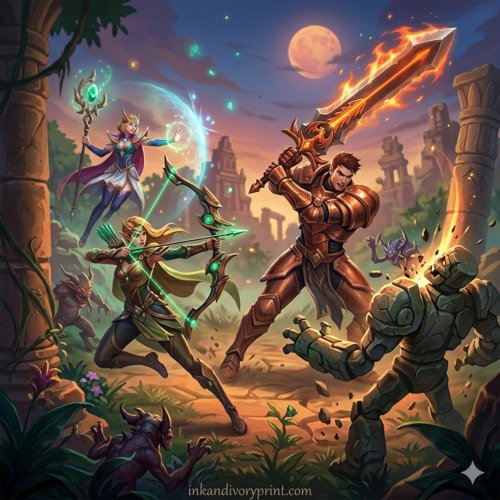
inkandivoryprint.com – Mobile Legends: Bang Bang is a game that rewards much more than mechanical skill. While quick reactions, accurate skill shots, and hero mastery are important, they are only part of the equation. Players who consistently climb the ranked ladder understand something deeper: every match is a strategic battle of resources, timing, positioning, and decision-making. The higher the rank, the less the game revolves around individual outplays and the more it revolves around controlling the flow of the match.
Many players become stuck because they focus exclusively on kills and personal statistics. However, experienced competitors recognize that kills are merely tools used to achieve larger goals such as objectives, map control, and economic advantages. Winning teams are often the teams that make smarter decisions rather than the teams with the most impressive highlight plays.
This guide explores advanced ranked strategies, efficient rotations, and practical systems that help players perform consistently regardless of role or hero preference.
Understanding Ranked Match Dynamics and Strategic Priorities
Why Objectives Matter More Than Kills
One of the biggest misconceptions among developing players is the belief that accumulating kills automatically leads to victory. While eliminations create opportunities, they do not directly win games. Objectives are what ultimately determine success.
Turrets open the map and remove defensive structures. Turtle provides valuable gold and experience advantages. Lord creates pressure that can break defensive formations and lead to game-ending pushes. These objectives generate long-term benefits that persist beyond individual fights.
A team may dominate in kills yet lose because they fail to convert those kills into objectives. Conversely, a disciplined team can secure strategic advantages through efficient objective control even when they are slightly behind in combat statistics.
Understanding this distinction changes how players approach the game. Instead of fighting simply because an opportunity exists, they begin asking what can be gained from the fight afterward. This mindset transforms decision-making and creates more consistent results.
Recognizing Power Spikes Throughout the Match
Every hero in Mobile Legends experiences moments when they become significantly stronger. These moments are called power spikes, and understanding them is essential for making effective decisions.
Some heroes gain strength after reaching a certain level, unlocking critical abilities that dramatically improve their effectiveness. Others rely on specific items before they can contribute meaningfully to teamfights. Recognizing these milestones allows players to choose favorable moments for aggression and avoid unnecessary risks during weaker phases.
Power spikes also apply to enemy heroes. Knowing when opponents become dangerous helps prevent avoidable mistakes. A player who understands enemy scaling can adjust positioning, farming patterns, and objective priorities accordingly.
High-level gameplay often revolves around exploiting power spikes while minimizing exposure during vulnerable periods.
Balancing Aggression and Patience
Aggression is important in Mobile Legends, but reckless aggression is one of the fastest ways to lose games. Successful players understand the difference between proactive pressure and unnecessary risk.
Proactive aggression occurs when there is a clear advantage, such as superior numbers, stronger itemization, or better positioning. Reckless aggression occurs when players fight simply because they see an opportunity for combat.
Patience is equally important. Sometimes the strongest move is waiting for an objective to spawn, allowing cooldowns to return, or letting waves push naturally before committing resources.
The best players strike a balance between aggression and restraint. They pressure opponents consistently while avoiding situations that offer low reward relative to the risk involved.
Advanced Rotations and Map Movement
Rotations are one of the most powerful tools available to any player. Proper movement across the map creates opportunities, protects teammates, and generates pressure that forces opponents to react.
An intelligent rotation begins with a purpose. Whether assisting a lane, contesting an objective, or securing vision, the movement should accomplish something meaningful. Random wandering wastes time and reduces overall efficiency.
Mid lane heroes often play a central role in rotations because of their ability to influence multiple areas quickly. Junglers rotate according to objective timing and resource availability. Roamers create opportunities by supporting allies and gathering information.
When rotations are coordinated and purposeful, teams maintain constant pressure while minimizing wasted movement.
Reading the Minimap Effectively
The minimap is one of the most valuable sources of information in Mobile Legends. Unfortunately, many players fail to use it effectively.
Strong players glance at the minimap frequently, gathering information about enemy positions, missing heroes, lane states, and objective timers. This information allows them to predict future movements and make informed decisions.
For example, if multiple enemies appear on one side of the map, opportunities may exist elsewhere. If an enemy hero disappears unexpectedly, caution may be necessary until their location becomes known.
Map awareness turns uncertainty into actionable information. Players who develop this habit often improve dramatically without changing any other aspect of their gameplay.
Controlling Key Areas of the Map
Certain locations naturally influence the outcome of matches more than others. River entrances, jungle intersections, objective zones, and central pathways all serve as strategic hotspots.
Controlling these areas provides vision, restricts enemy movement, and creates opportunities for ambushes or objective setups. Teams that consistently occupy important locations gain access to information while denying the same information to opponents.
Control does not always require fighting. Simply maintaining presence in key zones can force enemies into predictable routes and defensive behavior.
As matches progress, map control becomes increasingly important because objectives and teamfights occur more frequently around these contested areas.
Winning Teamfights and Closing Out Games
Positioning is one of the most influential factors in teamfight success. Even highly skilled players can become ineffective if they occupy poor positions.
Different roles require different positioning principles. Tanks typically operate at the front, creating space and absorbing pressure. Damage dealers remain at safe distances while contributing consistent output. Supports position where they can protect allies without exposing themselves unnecessarily.
Good positioning changes constantly as fights evolve. Players must adapt to enemy movements, ability usage, and shifting priorities. Remaining aware of surroundings is essential for maintaining effectiveness.
Strong positioning often determines whether a player survives long enough to influence the outcome of a fight.
Managing Cooldowns During Engagements
Abilities represent some of the most powerful tools available in Mobile Legends. Because they operate on cooldown systems, managing them effectively is crucial.
Using important abilities too early can leave players vulnerable later in the fight. Holding them too long can reduce overall impact. The challenge lies in finding the correct timing.
Experienced players track both allied and enemy cooldowns. They recognize windows where opponents lack critical abilities and use those opportunities to gain advantages.
Cooldown management becomes especially important in late-game situations where a single ability may determine the outcome of a decisive engagement.
Turning Teamfight Wins Into Game-Winning Advantages
Winning a fight is valuable, but its true value depends on what happens afterward. Many teams secure successful engagements only to waste the resulting opportunity.
The period immediately following a victory should be used to gain objectives, push lanes, secure vision, or establish map control. Every second counts because defeated opponents eventually respawn and return to the battlefield.
Effective teams transition smoothly from combat to objective play. They understand that the fight itself is not the goal—it is merely the mechanism that creates an opening.
This conversion process is one of the defining characteristics of high-level gameplay.
Developing a Reliable Hero Pool
Many players believe that mastering dozens of heroes is necessary for climbing ranks. While flexibility has value, a focused hero pool often produces better results.
Specializing in a limited number of heroes allows players to understand matchups, power spikes, itemization, and advanced mechanics more deeply. This knowledge leads to greater consistency and confidence.
A strong hero pool typically includes several options that cover different situations while remaining manageable enough to maintain proficiency.
Depth often provides greater competitive advantage than excessive breadth.
Learning From Defeats
Losses are inevitable in any competitive environment. The difference between improving players and stagnant players lies in how they respond to those losses.
Rather than focusing solely on teammates or external factors, successful players analyze their own decisions. They identify mistakes, examine missed opportunities, and look for recurring patterns.
Every defeat contains information that can improve future performance. Players who actively seek that information accelerate their growth significantly.
Learning from losses transforms setbacks into valuable educational experiences.
Maintaining Consistency Over Time
Climbing ranked is rarely about extraordinary performances. More often, it is about avoiding major mistakes and maintaining solid decision-making across many games.
Consistency comes from disciplined habits, emotional control, and adherence to strategic principles. Players who remain calm under pressure tend to make better decisions than those who become frustrated or overconfident.
Long-term success is built through repetition of good habits rather than occasional moments of brilliance.
The most successful players focus on processes rather than outcomes, trusting that strong fundamentals will produce positive results over time.
Conclusion Mastering Mobile Legends Ranked Play: Advanced Strategies, Smart Rotations, and Consistent Victory
Mobile Legends is a game of strategy, adaptation, and continuous improvement. While mechanical skill provides a foundation, lasting success depends on understanding objectives, rotations, positioning, and decision-making. Players who prioritize map control over random fights, convert advantages into objectives, and maintain disciplined gameplay habits consistently outperform those who rely solely on individual mechanics.
Advanced rotations create opportunities before combat begins. Smart objective management turns small leads into significant advantages. Strong teamfight execution ensures that those advantages are preserved and expanded. Finally, a commitment to learning and consistency enables long-term growth regardless of current rank.
As players develop these skills, they begin to experience Mobile Legends differently. Matches become less chaotic, decisions become more intentional, and victories become the result of strategy rather than chance. Through patience, practice, and a deeper understanding of the game, any dedicated player can achieve meaningful improvement and climb toward higher levels of competitive play.