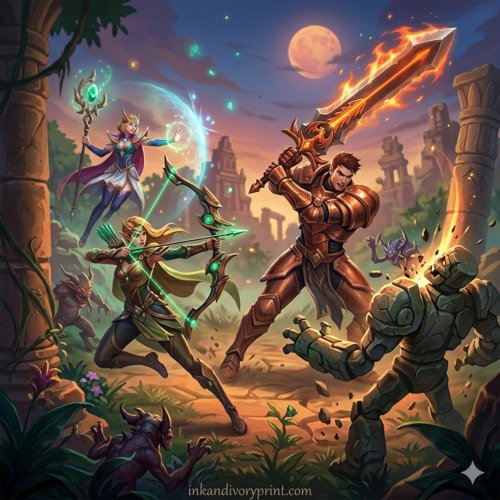
inkandivoryprint.com – Many Mobile Legends players believe that winning a teamfight depends entirely on mechanical skill. They spend countless hours practicing hero combos, improving their reaction speed, and memorizing damage calculations. While these abilities certainly matter, they rarely determine the outcome of high-level matches by themselves. The teams that consistently climb the ranked ladder usually possess something even more valuable: superior positioning. Proper positioning allows every hero to maximize their strengths while minimizing unnecessary risks, creating situations where even mechanically average players can outperform opponents with faster hands but poorer decision making.
Positioning begins long before the first skill is cast. Every player should already understand where they need to stand depending on their role, the enemy composition, available vision, and the objectives currently being contested. Instead of gathering in a random formation, disciplined teams naturally spread across the battlefield according to their responsibilities. Tanks and durable Fighters occupy the front, absorbing information and controlling dangerous choke points. Marksmen and Mages remain behind the frontline where they can deal continuous damage without exposing themselves to enemy crowd control. Assassins rarely reveal themselves immediately, preferring to wait patiently for vulnerable targets or wasted enemy abilities before committing to an engagement.
One of the biggest mistakes made by inexperienced players is standing too close together. Clustering gives opponents the perfect opportunity to land multiple crowd-control abilities simultaneously, instantly shifting the momentum of the fight. Maintaining appropriate spacing forces the enemy team to commit more resources to reach valuable targets while reducing the effectiveness of area-of-effect abilities. Likewise, standing too far apart creates a different problem, preventing teammates from protecting one another when sudden engagements occur. Successful positioning therefore balances safety with accessibility, ensuring every hero can contribute while remaining within supporting distance of allies.
Terrain also plays an enormous role in positioning. Bushes, walls, narrow jungle entrances, and objective pits all influence the effectiveness of different hero compositions. Teams that arrive first at important locations gain the advantage of choosing favorable angles while forcing opponents to approach through predictable paths. This positional superiority frequently determines the outcome before combat officially begins. Experienced players therefore spend as much attention controlling terrain as they do controlling enemy heroes, recognizing that the battlefield itself can become one of their strongest strategic tools.
Frontline Positioning That Creates Space for Damage Dealers
The frontline carries responsibilities extending far beyond simply absorbing damage. Tanks and durable Fighters act as the team’s protective shield while simultaneously controlling vision and restricting enemy movement. Their positioning determines whether fragile teammates can perform comfortably or spend the entire fight running for survival.
Rather than charging recklessly toward the opposing team, experienced frontliners establish gradual pressure. They occupy threatening positions that discourage enemy advances while maintaining escape routes if unfavorable situations develop. Their presence creates space where Marksmen and Mages can safely attack without immediately becoming priority targets.
Effective frontliners also understand patience. Initiating every available opportunity often produces disastrous results because teammates may not yet be in position to follow. Instead, they constantly monitor ally positioning before engaging, ensuring that every initiation can actually be supported. This discipline transforms aggressive play into calculated decision making rather than reckless gambling.
Protecting Backline Heroes Throughout Extended Engagements
Backline heroes generate most of the team’s sustained damage, making their survival essential during prolonged engagements. Nevertheless, protection involves much more than simply standing nearby. Every teammate shares responsibility for creating safe conditions that allow damage dealers to perform efficiently.
Supports and Roamers frequently remain slightly beside rather than directly in front of Marksmen, enabling rapid responses to incoming Assassins. Fighters may temporarily abandon offensive pressure to intercept diving enemies before returning to the frontline. Mages contribute defensive crowd control whenever enemy initiators threaten vulnerable allies.
Meanwhile, Marksmen themselves should continuously reposition between attacks instead of remaining stationary. Small adjustments after every basic attack significantly reduce vulnerability while maintaining consistent damage output. This movement becomes increasingly important during late-game encounters where even brief exposure may result in immediate elimination.
Positioning Around Objectives Instead of Chasing Kills
Many teamfights occur near Turtle, Lord, or important structures rather than open areas. Consequently, positioning should prioritize objective control over individual eliminations. Teams that abandon advantageous locations to chase retreating opponents frequently lose control of the battlefield despite initially winning the exchange.
Remaining disciplined around objectives allows stronger formation, superior vision, and easier transitions into subsequent strategic advantages. Even if several enemies escape, securing Lord or destroying multiple turrets usually provides far greater long-term rewards than pursuing uncertain eliminations across unfamiliar territory.
Mastering Timing to Win Teamfights Consistently
Positioning determines where players stand, but timing determines when they act. Perfect positioning combined with poor timing often produces disappointing results, whereas average positioning supported by excellent timing can completely transform difficult engagements. Learning when to engage, retreat, or delay action separates experienced competitors from players who rely entirely upon instinct.
Waiting for Key Enemy Abilities Before Committing
One of the defining characteristics of disciplined players is patience. Rather than immediately activating every available ability, they first observe how opponents begin the engagement. Major crowd-control abilities, defensive ultimates, mobility skills, and burst combinations often determine whether an aggressive play succeeds or fails.
Assassins provide the clearest example of this principle. Diving into the enemy backline before defensive abilities have been used frequently results in instant elimination. Waiting several seconds, however, often creates perfect opportunities once enemy resources become unavailable. This patience dramatically increases success rates while reducing unnecessary risks.
Damage dealers likewise benefit from delayed aggression. Allowing frontliners to absorb initial pressure before entering optimal attack range preserves valuable positioning while ensuring continuous damage throughout the remainder of the fight instead of only during its opening moments.
Synchronizing Every Role During Engagements
Successful teamfights rarely consist of five players acting independently. Instead, every role performs complementary actions that gradually build toward overwhelming momentum. Tanks initiate only after teammates indicate readiness. Mages immediately follow with crowd control. Marksmen begin sustained damage once frontline stability has been established. Assassins exploit openings created by previous abilities rather than creating isolated engagements alone.
This synchronization minimizes wasted cooldowns while maximizing overall effectiveness. Even powerful individual abilities lose much of their impact when used separately. Layering crowd control sequentially rather than simultaneously extends total control duration, giving damage dealers additional opportunities to eliminate priority targets.
Communication greatly enhances this coordination, but even teams without voice chat can achieve remarkable synchronization by carefully observing ally positioning and movement before committing fully.
Recognizing When Not to Fight
Perhaps the most underrated aspect of timing is understanding when combat should be avoided entirely. Many ranked matches are lost because players believe every visible opponent represents an invitation to engage. In reality, numerous situations strongly favor temporary withdrawal instead.
Fighting while important ultimates remain unavailable, contesting objectives with numerical disadvantages, entering unexplored jungle areas without vision, or pursuing opponents beneath defensive structures often produces unnecessary losses. Experienced players evaluate these circumstances objectively rather than emotionally.
Choosing to retreat should never be mistaken for weakness. Preserving resources, regrouping with teammates, pushing additional waves, or waiting for favorable cooldowns frequently creates significantly stronger opportunities only moments later. Strategic patience consistently outperforms impulsive aggression over the course of long ranked sessions.
Reading Every Fight Before It Begins
Excellent teamfighters begin analyzing engagements several seconds before abilities are exchanged. They identify likely initiation angles, determine priority targets, anticipate enemy flanking routes, and mentally prepare responses to different scenarios. This preparation reduces hesitation while improving reaction quality under pressure.
Players should constantly evaluate available vision, remaining cooldowns, item completion, and lane pressure before deciding whether engagements truly benefit their team. Entering battles with complete information dramatically increases consistency across matches.
Adjusting to Different Enemy Compositions
Every enemy lineup requires different positioning and timing principles. Burst compositions demand cautious spacing and disciplined patience. Sustain compositions require prolonged engagements with careful resource management. Heavy crowd-control teams emphasize defensive positioning and protective coordination, while highly mobile compositions reward flexible formations capable of responding quickly to unpredictable movement.
Adapting continuously rather than relying upon fixed habits allows players to remain effective regardless of draft differences. This flexibility distinguishes experienced competitors from individuals dependent upon repetitive strategies.
Maintaining Discipline During Late-Game Teamfights
Late-game engagements often determine the outcome of the entire match because respawn timers become extremely long. Consequently, every positioning mistake and every poorly timed ability carries significantly greater consequences than during earlier stages.
Disciplined teams therefore slow the pace intentionally. They establish vision before advancing, maintain proper spacing, preserve critical abilities until necessary, and focus on objective security after successful engagements rather than extending risky pursuits. Their confidence comes from consistency rather than recklessness.
Players who repeatedly practice these habits eventually discover that victories feel less dependent upon extraordinary mechanical moments and more upon reliable strategic execution. Teamfights become predictable sequences of intelligent decisions rather than chaotic exchanges of abilities.
Conclusion Mastering Teamfight Execution in Mobile Legends: The Ultimate Guide to Positioning and Perfect Timing
Mastering teamfight execution in Mobile Legends requires far more than mechanical excellence. Superior positioning creates safe opportunities for every role to contribute effectively, while intelligent timing ensures that every engagement begins under favorable conditions. By protecting the backline, coordinating initiations, respecting cooldowns, controlling terrain, and recognizing when patience provides greater value than aggression, players transform ordinary encounters into decisive victories. As these habits become instinctive, every match becomes less about reacting to chaos and more about controlling it, allowing consistent success regardless of the hero or role being played.